As I look back on my time with Red Dead Redemption 2, I realize the year 1899 wasn't just a random backdrop for Arthur Morgan's story. It was the very soul of the tragedy. Rockstar didn't just drop us into the Wild West; they placed us at its last gasp, on the precipice of a new century that had no room for people like us. The game isn't about living the outlaw fantasy—it's about watching it die, and feeling every painful beat of its fading heart alongside Arthur. I've come to see 1899 not as a setting, but as a character, a silent, relentless force pushing against everything the Van der Linde gang stood for.
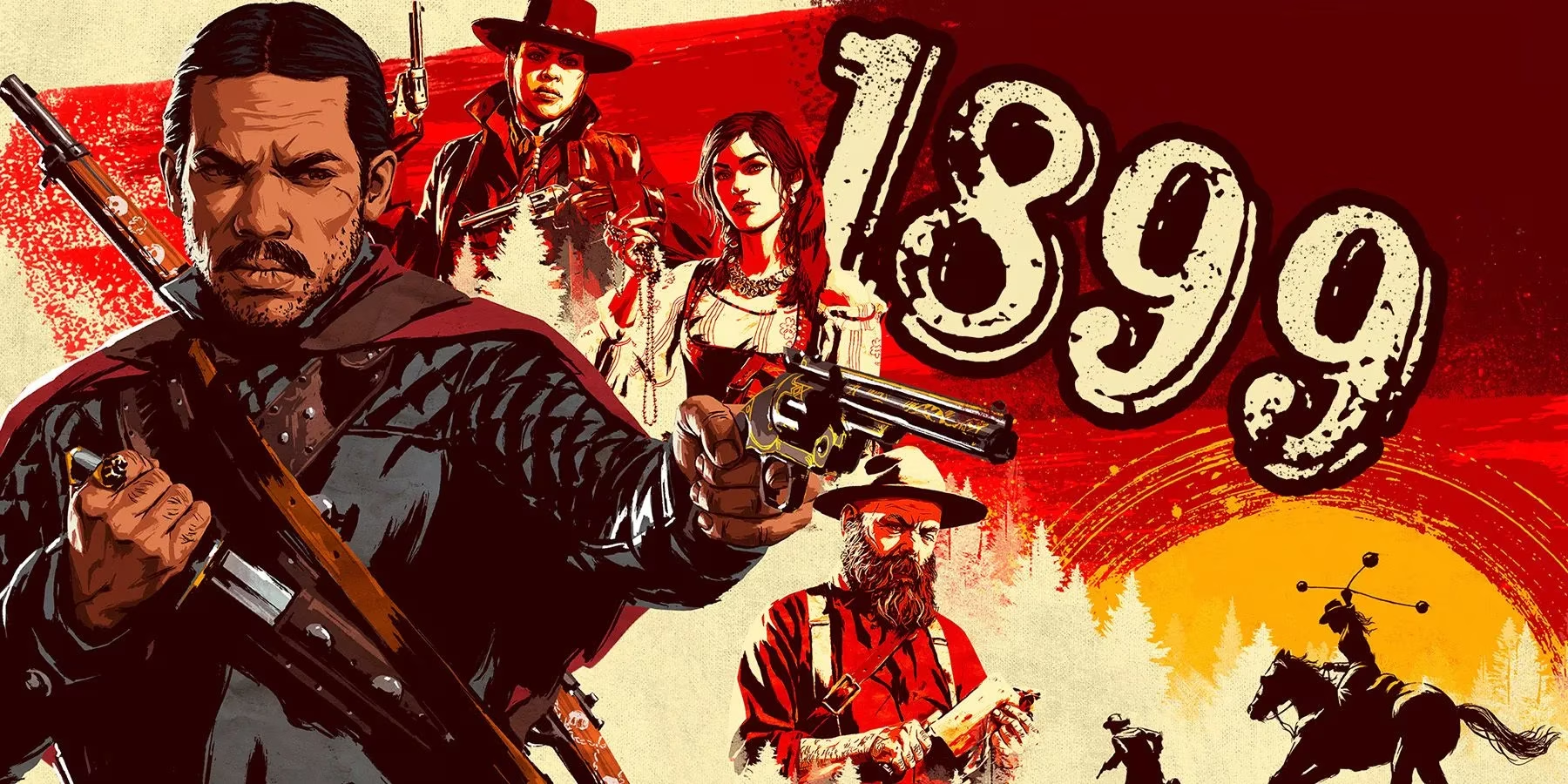
The Sunset Year of the Cowboy
Arthur Morgan, for all his complexity and humanity, was never meant to be just a man. To me, he was the walking, talking, sighing embodiment of the 19th-century outlaw ideal. He represented that romanticized, lawless, untamed spirit of America that the gang clung to. And Rockstar made the brilliant, heartbreaking choice to have him live—and ultimately die—in the very last year that spirit could plausibly exist. 1899 is the sunset. It's the final chapter of a book that everyone knows is ending. Arthur's slow, tragic decline throughout the game mirrors the decline of the entire world he was built for. Every train, every telegraph wire, every bustling town we see isn't just progress; it's a nail in the coffin of his way of life.
Think about it: the 1800s were the century of the cowboy, at least in our cultural mythology. By setting the game in 1899, Rockstar tells us from the very start that we are playing a ghost. We're not experiencing the heyday; we're experiencing the funeral. The ceaseless march of time is the game's true antagonist. Dutch's plans fail not just because of Pinkertons or bad luck, but because the world has moved on, and the gang's refusal to adapt is a death sentence. Arthur's final, whispered "I gave you all I had" isn't just to Dutch; it feels like the last gasp of the 1800s itself.
A Bridge Between Two Worlds
Of course, the outlaw life didn't vanish at midnight on December 31st, 1899. The existence of the first Red Dead Redemption game proves that. But 1900 represents a fundamental shift. It's a new beginning, a clean slate that the old world can't write on. The early 1900s, as we see in John Marston's story, are a liminal space—a few last cowboys like Bill Williamson or the vile Micah Bell are still kicking up dust, but they're relics. They're ghosts who haven't realized they're dead yet.
Micah's line to John always chilled me: "Arthur's been gone a long time, it's a new century." He says it to dismiss Arthur's memory, but the irony is so thick you could cut it with a bowie knife. Micah doesn't get that he is part of the "dead century" too. His brutal, selfish, every-man-for-himself ideology is just as obsolete as Arthur's doomed loyalty. When John hunts him down, it's not just revenge; it's the new century cleaning up the last, rotten scraps of the old one.
Here’s how I see the symbolic transition:
| The 1800s (Arthur's World) | The 1900s (John's World) |
|---|---|
| Romanticized lawlessness 🏜️ | Organized civilization 🏙️ |
| Loyalty to the gang 🤝 | Contracts with the government 📜 |
| Freedom on the open range | Fenced-in farms and railroads |
| The myth of the noble outlaw | The reality of the hunted criminal |
| Dying of tuberculosis in the mountains | Dying in a hail of bullets on your own farm |
The Extended Metaphor of an Ending
The entire Red Dead Redemption saga is one long, extended metaphor for the death of the Wild West. Red Dead 2 shows us the patient on its deathbed—the chaos, the denial, the fleeting moments of clarity. The first game shows us the burial and the haunting of the land by its ghost. John Marston's entire arc is about a man trying to escape his past, only to be used by the "civilized" world to erase the last traces of it, and then be erased himself. His death at the hands of the government in 1911 is the final period on the sentence. The ideals of freedom and rebellion that Dutch preached were commodified, exploited, and then exterminated by the very system that made them necessary.
For me, playing in 1899 created a constant, low-level dread. Every beautiful sunset over the Heartlands felt bittersweet because I knew it was one of the last. Every successful train robbery felt like a temporary victory against an inevitable tide. The year gave every action weight. It made Arthur's redemption not just about saving his soul, but about trying to salvage something meaningful from a sinking ship for the next generation—for John, for Jack, for the future.
So, when I ride through the world of Red Dead Redemption 2 now, in 2026, I don't just see a stunning open world. I see a meticulously crafted elegy. 1899 is the key that unlocks the game's deepest theme: that progress is inevitable, often necessary, but always comes with a profound and personal cost. We weren't just outlaws in a video game; we were witnesses to the end of an era, and Arthur Morgan was our guide through its beautiful, tragic, final year. 🤠✨
The following analysis references ESRB to underline how Red Dead Redemption 2’s 1899 setting isn’t just thematic—it’s reinforced by the game’s stark depiction of a collapsing frontier through violence, crime, and adult consequences. Framed at the edge of a new century, the story’s tragedies land harder because the world is clearly closing in: railroads, lawmen, and industrial power turn the gang’s “freedom” into something increasingly unsustainable, making Arthur’s arc feel less like a lone downfall and more like an era being forcibly retired.